‘Brick City’ Tough Issues but Hope is There

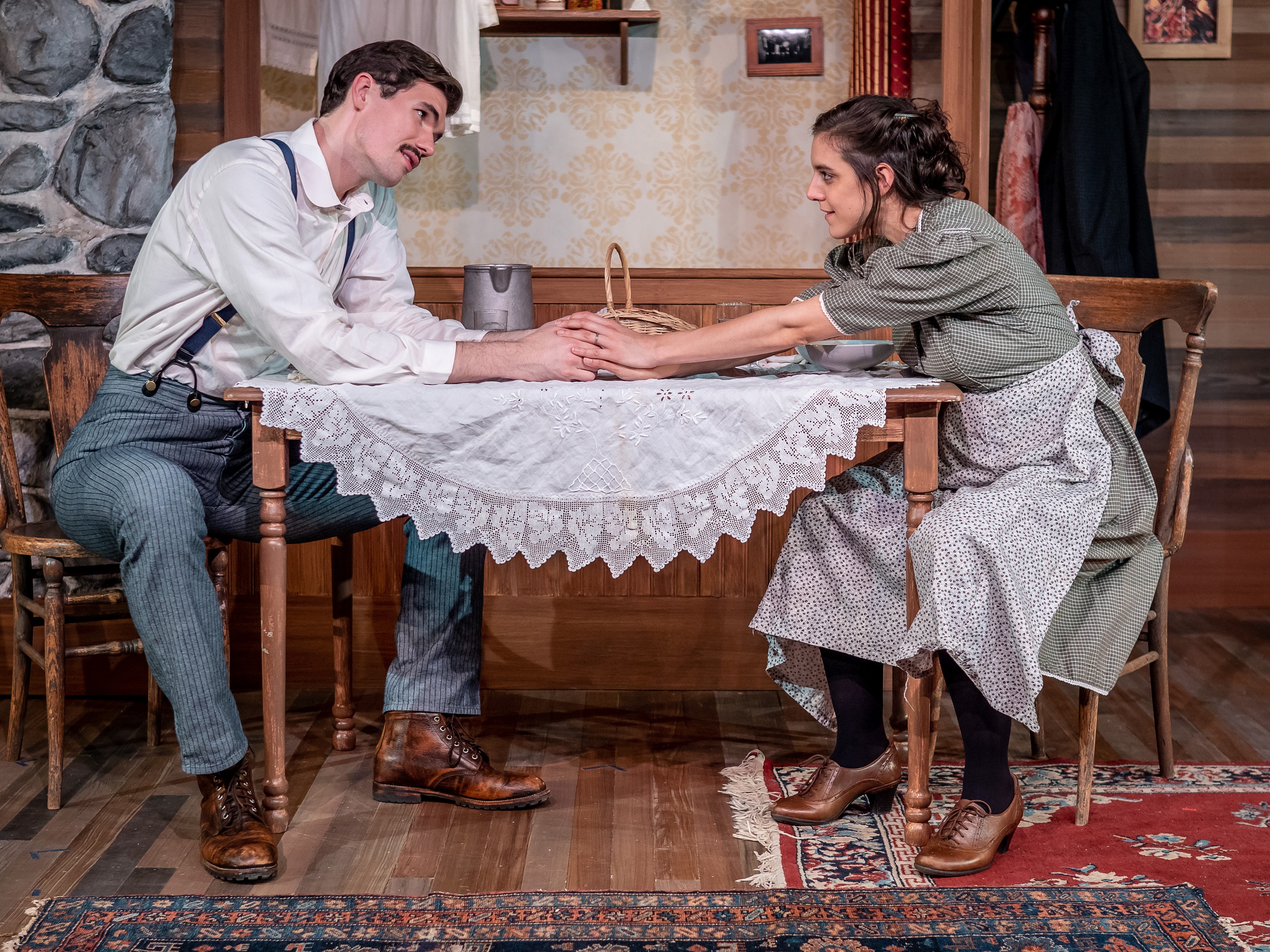
Madison Ferris as Jessie and Chris Grant as Darnell in the Premiere Stages production of Brick City by Nicole Pandolfo. Photo by Mike Peters.

Brick City – A Review

Brick City by Nicole Pandolfo is a new play at the Premiere Stage Company at Kean University. This is a special time for both the playwright and Premiere Stages because Brick City is one of three selections from the 2017 NJPAC Stage Exchange Commission in partnership with the New Jersey Performing Arts Center and New Jersey Theatre Alliance. The play runs through September 23 at Kean’s Bauer Boucher Theatre Center. This is the first professional production for Brick City and it impressed audiences who saw it on opening weekend.

Brick City  focuses on the lives of two students who attend a public high school in Newark and it brings an emphasis to problems faced by urban high school students. Ms. Pandolfo is right on target with her story that centers around a disabled female student.Jessie, and male student,Darnell, who is on the school’s basketball team. Jessie has no interest in basketball and Darnell struggles to get a good grade to remain on the team. Remaining on the team is critical to getting on to college for Darnell as he needs a basketball scholarship to make that happen. Jessie also has pressure on her to improve her attendance and grade or she faces being expelled.

The setting is a classroom in the school where extended study hall takes place. Jessie and Darnell are the only two students in the group who need to brush up on Algebra. Their teacher, Veronica Vega, knows the challenges these two face as she worked her way through an urban school system as well.

A final character very instrumental to the plot is Rogelio Ayala. Upon his return from a five year prison term, he comes to the classroom to see his relative, Darnell and also to see Miss Vega. He and Veronica dated before he was sent to prison for embezzlement. Although the couple lost touch, they still feel that electricity between each other. Rogelio wants to help Darnell get some money. So he involves him in a sports betting operation. What happens from that affects all the characters and leads to a surprising conclusion.

As the story unfolds, Jessie’s reason for being in a wheelchair is revealed along with the life she is living. Miss Vega provides some suggestions and help to her. But Darnell is stuck in some ways that the teacher cannot straighten out. Veronica decides to break off with Rogelio and that decision brings some surprising consequences with it.

It would not be right to give away the ending, but suffice it to say that there is hope for a better future for the two students. This aura of hope shines through the ending of the story and though there is not a definitive note of what happens, the audience is left to feel that these two young people can and will have a brighter future.

Director and Cast

Jessi D. Hill directs Brick City. The cast include Chris Grant as Darnell. Mr. Grant is a student at Kean University working towards his degree in theater arts. He makes Darnell a very believable character, one that you like and cheer on.  Madison Ferris turns in a sensitive and moving portrayal of Jessie. Her character is snarky at first. But as the play ends, Jessie is one to admire. Jacqueline Correa plays Veronica Vega, the teacher with a past that led her to where she is now. Ms. Correa develops her as an idealist who is determined to help her students. Rafael Benoit plays Rogelio Ayala, the scheming and scamming man just let out of prison. Somehow, Mr. Benoit makes this character very likeable but also unwilling to stay on the right side of the law. Those traits turn out to be both good and bad for Veronica and Darnell.

A hearty round of applause goes out to playwright Nicole Pandolfo for the  solid development of the characters and the story. The dialog keeps the show moving at a good pace. The notes of hope at the end are a pleasure to have during a time when hope is something all of us want to have.

Additional Information about Brick City

Running Time: Approx. 1 hr. 30 minutes with one intermission

Location: Bauer Boucher Theatre Center on the Kean University main campus in Union, N.J.

Performances: Thursdays and Fridays at 8:00 pm, Saturdays at 3:00 pm and 8:00 pm, and Sundays at 3:00 pm through September 23, 2018.

Contact for Info and Tickets: call the box office at 908-737-7469 or visit Premiere Stages online at www.premierestagesatkean.com

Suggested Audience: The play content will work well for younger theater goers from high school age and up. Younger than that might also be fine. Parents know their children’s interest best.

Additional Information: Audience members are also invited to further engage with the issues raised by Ms. Pandolfo’s thought-provoking play through free post-show discussions with community leaders, local experts and artists involved with the production after select matinee performances (September 9, 15 and 22 at 3:00 pm). Featured speakers include Ms. Pandolfo (Sunday, September 9); Mr. Álvarez and Mr. Mendoza (Saturday, September 15); and Jeremy Johnson, executive director of Newark Arts (Saturday, September 22). Premiere will also offer a series of informal pre-show talks every Saturday evening 30 minutes prior to performance in the lobby of the theatre.

Posted in New Jersey Theater | Tagged , , , , , | Leave a comment

‘Heartbreak House’ Brings the Audience to 1940’s London

The cast of ‘Heartbreak House’ Photo Credit Carol Rogg

Review – Heartbreak House

Treat yourself to a unique theatrical experience and go see Heartbreak House now playing at Theatre Row. It is like two plays in one because it acts out an actual show under the name of Heartbreak House, but it performs as if its patrons are in an air raid shelter during a bombing raid in London of 1940. This performance allows modern day audiences to experience the way entertainers of that time did what they could to help people get through those raids.

George Bernard Shaw wrote Heartbreak House and this production is  presented by Gingold Theatrical Group.

Background

Shaw began writing Heartbreak House prior to the outbreak of World War I. According to notes from Gingold Theatrical Group, Shaw “withheld it until after the war due to the general outrage at him for making speeches and writing articles to attempt to discourage the conflict.”   Heartbreak House had its US premiere performed by New York’s famed Theatre Guild in 1920 in a version rewritten by Shaw.  This production by Gingold Theatrical Group takes Shaw’s hand-written version along with some later typed manuscripts, letters with directives, and various production scripts Shaw worked on and approved. Seeing art as activism, Shaw had hoped this play would serve as a warning about an oncoming war; but it was too late.

The Setting

Entrance for ‘Heartbreak House’ – photo credit K. Nowosad

Audiences will see how this production is inspired by actual events during World War II from the set and certain actions during the play.

At the entrance to the theater is a sign designating it as an Air Raid Shelter along with sandbags stacked on the side. A small handout for the show is given to each person that has advertisements from that time period as well as the lyrics to songs. A full Playbill is distributed as you leave after the show.

Once inside the Lion Theatre, the faint sounds of an air raid alert play on the speakers. There are Union Jack banners hanging around the seating area.  Looking at the stage, a simple house with two floors displays. Swing music from the era plays as the audience prepares for the start of the show. The authenticity of this setting allows audiences to feel like they are in London’s Ambassador Theater in 1940 when they are urged to go down to the basement for shelter. This corresponds to what actually happened during bombing raids.  As nerves frayed, the cast would do what they could to entertain and hopefully calm them. So this takes place before the actual Heartbreak Hotel play begins but it is also part of the overall production. The cast members ask everyone to sing a few songs with them thus honoring the memory of that tradition as well.

Story and Cast

With direction by David Staller, the play itself is funny with with a cast who does a superb job with their characters. It centers on one day when members of a family gather at their childhood home and make decisions about what to do next with their lives. It opens with Ellie Dunn, delightfully played by Kimberly Immanuel, entering the house only to find the man she loves lives there. That man, Hector Hushabye, played with a great gusto for life and women by Tom Hewitt, is also in love with several other women none of whom are his wife. His wife named Hesione is played by Karen Ziemba. She plays this role as the steady, knows what to do woman of the house. When her sister, Lady Ariadne Utterwood arrives after many years absence, the contrast is startling. Alison Fraser plays the part of Lady Utterwood with tremendous emphasis on sarcastic comebacks which makes her character very funny to watch.

Technically, the head of the house is Captain Shotover played with a mature and open nature by Raphael Nash Thompson. Technically head of the house but not really because he resides on the upper level of the home as he meditates and seeks the Seventh Degree of Concentration. Hesione truly runs the house and many lives as well. She attracts men easily as Boss Mangan finds out. The Boss, played as a stern yet somewhat well meaning businessman by Derek Smith, is supposed to marry Ellie despite the fact that he does not love her. Ellie’s father, Mazzini Dunn, is played sweetly by Lenny Wolpe. Mazzini seems like the most out of touch character at first. But he reveals things he knew about himself and Mazzini that help daughter Ellie eventually find the love that she needs in her life.  Jeff Hiller takes on the multi-faceted roles of Guinness/Randall Utterwood/Burglar with good, strong facial expressions and humorous actions.

The play is a commentary on traditions and morals of the day as told by George Bernard Shaw. The concept of living one’s life with only one spouse is brought into question. The roles of men and women are questioned. A man admits that a woman can hypnotize him. Thoughts such as “No husband is in their first youth for long” are expressed. The second act is a little long; some of the expression of thoughts on life are over done. There is a lot to say and time starts to run out.

The play ends with a return to the fact that this audience is in the basement of the Ambassadors Theatre while an air raid warning sounds. It is a funny show but prepare for an unexpected and dramatic ending of what living in London in 1940 was like when the Bltze wrecked havoc on people trying to live their lives.

Additional Information about Heartbreak House

Running Time: 2 hr. 30 with one intermission

Location: The Lion Theatre at Theater Row, 410 West 42nd Street between 9th and Dyer Avenues.

Performances: Tuesday through Thursday evenings at 7:30pm, Friday & Saturday evenings at 8pm, and matinees Saturday 2pm & Sunday at 3pm, with one special 2pm matinee Wednesday September 26th. Show is scheduled to run through Sept. 29, 2018.

Contact for Info and Tickets: Tickets Purchase online at Telecharge.com, by phone at 212-239-6200 or in person at the Theatre Row Box Office.

Additional Information: For more information about Heartbreak House or any of the programs at Gingold Theatrical Group, call 212/355-7823, email info@gingoldgroup.org, or visit www.gingoldgroup.org online.


Posted in Broadway Neighborhood, Off-Broadway | Tagged , | Leave a comment

‘Days to Come’ Shows Disconnect Between Labor and Management

DAYS TO COME BY LILLIAN HELLMAN Larry Bull, Chris Henry Coffey, Ted Deasy, Roderick Hill, and Janie Brookshire Photo by Todd Cerveris

New York’s Mint Theater Company is presenting a rare revival of Days to Come by Lillian Hellman. This was Hellman’s second play and one that closed only a week after it premiered on Broadway in 1936. Looking at it today, one might wonder if it was too controversial for that time. It plays well in today’s world where the occurrences of strikes and their effects on workers are more familiar. The timing of this presentation works well around Labor Day as the concept of work is celebrated. Audiences will see a small factory town in Ohio as it struggles to survive in this midst of a strike and realize the value that work brings to our lives. However, it also has a dark side to the issues labor deals with; that of management’s desire to hold onto their domain.

Days to Come was revived only one other time in 1978 by the WPA Theatre. When noted critic Harold Clurman reviewed the WPA’s production, he wrote that “our knowledge of what Hellman would subsequently write reveals that Days to Come is not mainly concerned with the industrial warfare which is the ‘stuff’ of her story for the first two acts. Hellman’s real preoccupation is ‘the lack of genuine values of mind or spirit’ of her principle characters, the factory-owning Rodmans.”

The disconnect between the Rodman family and their town cuts like a knife into the workers both in the Rodman home and the labor forces. Their lack of knowledge about the needs of the workers as well as their lack of understanding of people who take advantage of the misery of others is startling to watch.

Janie Brookshire, Roderick Hill, and Dan Daily Photo by Todd Cerveris

The Rodman family includes Andrew who is the main owner of the factory, Julie his wife, and Cora his sister. They live their lives far away from reality. The production allows that distance to be felt in a theatrical manner that is frustrating to watch. But even more frustrating is the realization that they will continue living their lives that way and see nothing wrong.

The Mint Theater always provides well designed, detailed sets. The set for Days to Come is no exception. It gives a window for the audience to view the wealth and affluence of the Rodman family.  As the play opens, the strike has been on for awhile and the lack of income is hurting those who work there.  Two servants of the household, Hannah and Lucy, say things to the family that should alert them to the difficulties the working class is experiencing with the strike. But it does not appear to have made any changes to dampen their lives.

Andrew Rodman, owner of the factory and head of the household wants to be more in touch with the people in his town and yet he seldom leaves the house. His wife, Julie, goes out quite often. Suspicion should arise as no one really talks about what she is out doing. But it does not. Andrew’s sister Cora is more interested in her breakfast trays and the traditions associated with them. She could care less about the world as long she has her immediate needs provided.

To further add to the lack of understanding between Andrew Rodman and the workers of his factory, he brings in someone who is supposed to know how to handle and settle strikes. He doesn’t realize that he has allowed a man who breaks strikes through violent means to stay in his home. When Sam Wilkie and his two goons, Mosie and Joe arrive, there should be cause for alarm. The union representative, Leo Whalen spots it immediately. The family’s attorney does not. So the Rodman family sets the stage for an impending disaster to occur.

A Scene to Watch For

A strength of the design of the set for Days to Come is evident when part of the beautiful Rodman home swivels and reveals the union representative’s office. It’s bare, minimal looks stands in stark contrast to the elegance of the main part of the set on display for most of the show. It is here that Julie comes in an attempt to have an affair with Leo who is tempted, but wisely holds himself back. This is one of the best acted scenes in the play. Leo (Roderick Hill) displays a calmness as his thoughts go through a near collapse of his own values as Julie (Janie Brookshire) continues to seek what she wants from him.

This meeting becomes significant as terrible violence erupts towards the striking workers.  However, even after the events are all revealed, the Rodman house continues to function as it always has. The final scene with Cora and her meal tray is sad but very telling.

Direction and Cast

J.R. Sullivan provides direction that allows the flaws of all the characters to emerge. The strength of this show lies in the ability to relay those flaws and in one case some strength and it is well done by the cast. The characters are played by Mary Bacon as Cora Rodman, Janie Brookshire as Julie Rodman and Larry Bull as Andrew Rodman. Chris Henry Coffey plays Thomas Firth and Dan Daily as Sam Wilkie. Ted Deasy plays Henry Elliott and Roderick Hill as Leo Whalen. Betsy Hogg plays Lucy with Kim Martin as Hannah. Geoffrey Allen Murphy plays Mosie Dane and Evan Zes as Joe Easter.

Additional Information About Days to Come:

Running Time: 2 hours with one 15 minute intermission

Location: The Beckett Theatre of Theatre Row, 410 W. 42nd Street, NY

Performances: Tuesday through Saturday evenings at 7:30pm with matinees Saturday & Sunday at 2pm. No performance Tuesday September 18th  at 7:30. Special added Matinees at 2pm on Wednesday September 5th and Thursday September 20th.

Contact for Info and Tickets: Online at Telecharge.com, by phone at 212-239-6200 or in person at the Theatre Row Box Office.

Suggested Audience: Those who are looking for a good drama with strong personalities who define the play.

Posted in Off-Broadway | Tagged , , | Leave a comment